PhD Researcher · INSAIT Sofia
Halacheva
3D Computer Vision · Vision-Language Models · Embodied AI
Advised by Prof. Luc Van Gool and Prof. Danda Paudel at INSAIT. My research explores how machines can develop scene intelligence: understanding the physical structure of the world, grounding language in 3D environments, and reasoning about space in ways that support future embodied agents.
Towards embodied scene intelligence: enabling machines to understand, describe, and reason about the physical world.
My work investigates how intelligent systems can obtain an understanding of real-world 3D environments. While modern AI can recognize objects and answer questions about images, embodied agents require a deeper understanding: they must reason about physical structure, semantic meaning, and spatial relationships simultaneously.
To address this challenge, I explore scene-centric 3D methods that connect perception, language, and interaction. My research spans articulated object understanding, 3D vision-language models, and robust grounding mechanisms that encourage genuine visual-spatial reasoning rather than shortcut learning.
I
Physical Understanding
Understanding how objects are structured, articulated, and capable of interaction within real-world environments.
II
Semantic Understanding
Understanding what is present in a scene and connecting visual observations with open-ended language and world knowledge.
III
Spatial Reasoning
Understanding where things are, how they relate to one another, and reasoning about locations, context, and geometry in 3D space.
No publications found for this tag.
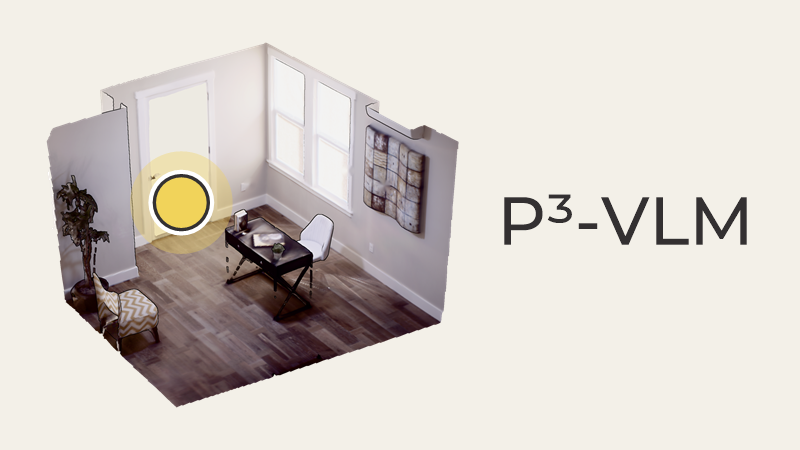
P³-VLM: A Point-based Alternative for Grounded 3D Vision-Language Models
Identifies a shortcut in how 3D vision-language models learn grounding: when asked about an object marked by a bounding box, the box's size and position already give away much of the answer, through both the text prompt and the model architecture. Replaces the box with a single 3D point, under which existing models lose much of their accuracy, and introduces P³-VLM, a 3D VLM designed for point prompts.
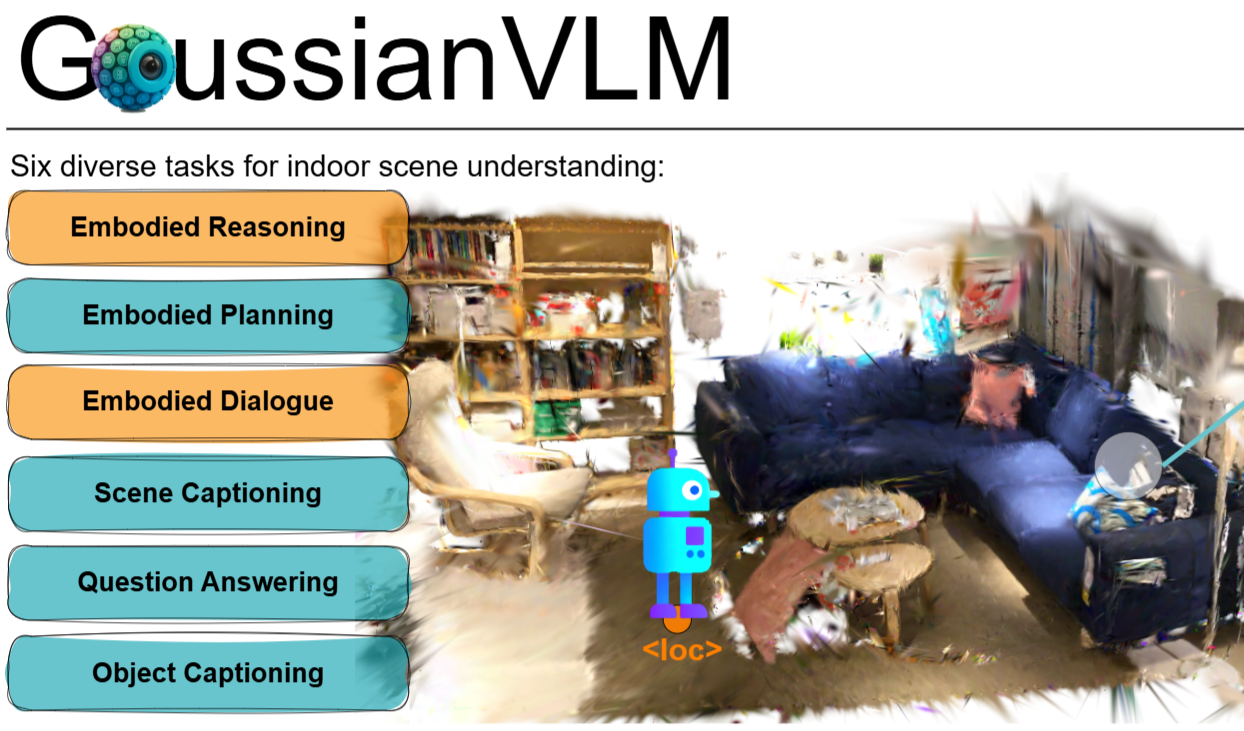
GaussianVLM: Scene-Centric 3D Vision-Language Models Using Language-Aligned Gaussian Splats for Embodied Reasoning and Beyond
Introduces the first 3D vision-language model operating natively on Gaussian splats, without object detectors. A dual sparsifier distills about 40k language-aligned Gaussians into 132 task-aware tokens, achieving state-of-the-art results across 3D VQA benchmarks and fivefold gains out of domain.
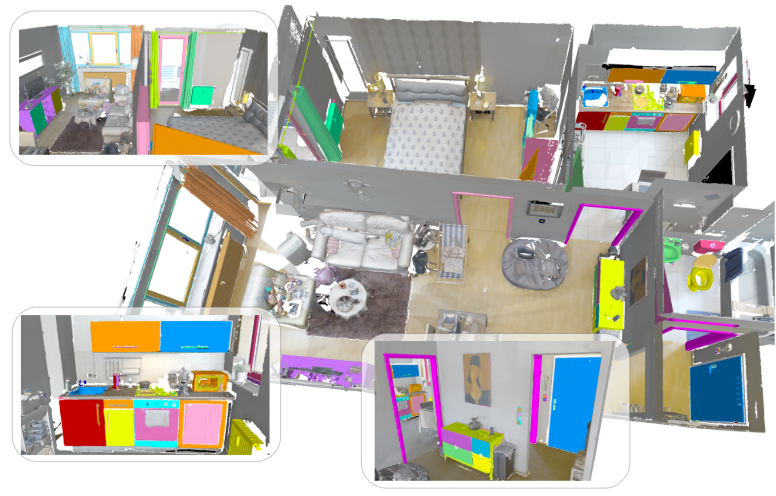
Articulate3D: Holistic Understanding of 3D Scenes as Universal Scene Description
Introduces a dataset of 280 indoor scenes in Universal Scene Description format, annotated with object and part segmentation, motion parameters, movable and graspable regions, connectivity, and object mass, so scenes can be used directly in downstream tools. Proposes USDNet, which jointly segments movable and graspable parts and predicts their articulation from scene point clouds, and establishes a benchmark for articulated scene understanding.
Top Reviewer
NeurIPS 2026
Top 5% Reviewer
CVPR 2026
EU State of the Union Address
Featured by President Ursula von der Leyen in her annual address to the European Parliament as an example of European AI effort.
Google DeepMind Fellowship
PhD sponsorship and mentorship
Forbes Bulgaria 30 Under 30
Technology & Innovation
IBM Female Talents Network and Mentoring Program
Network and mentoring program
DAAD Undergraduate Fellowship
Fellowship for undergraduate programs by the German Academic Exchange Service
AEB SE Fellowship
Fellowship for undergraduate programs by AEB SE, Germany
Bulgarian National Diploma
Highest national distinction for high school graduates in Bulgaria
PhD in Computer Science
INSAIT · Sofia · Advised by Luc Van Gool & Danda Paudel
Graduate Research Fellow, 3D Vision
INSAIT · Sofia · Advised by Luc Van Gool & Danda Paudel
M.Sc. Computer Science with distinction
University of Stuttgart
AI Engineer MSc Student Position
Client Engineering,IBM Germany, Ehningen
B.Sc. Software Engineering
University of Stuttgart
Selected workshop organization, supervision, reviewing, and public-facing activities around computer vision and AI research.
I help organize the OpenSUN3D workshop series, with responsibilities around organization, challenges, and program.
Reviewing activity for computer vision, robotics, and machine learning venues.
Student supervision and mentoring alongside research activities at INSAIT.
Selected media and public conversations related to AI research.
And others.